Changelog

A more personal writing workspace

Feldar 1.1 makes AI-assisted writing more personal, adds newer models, and strengthens drafting across sessions.
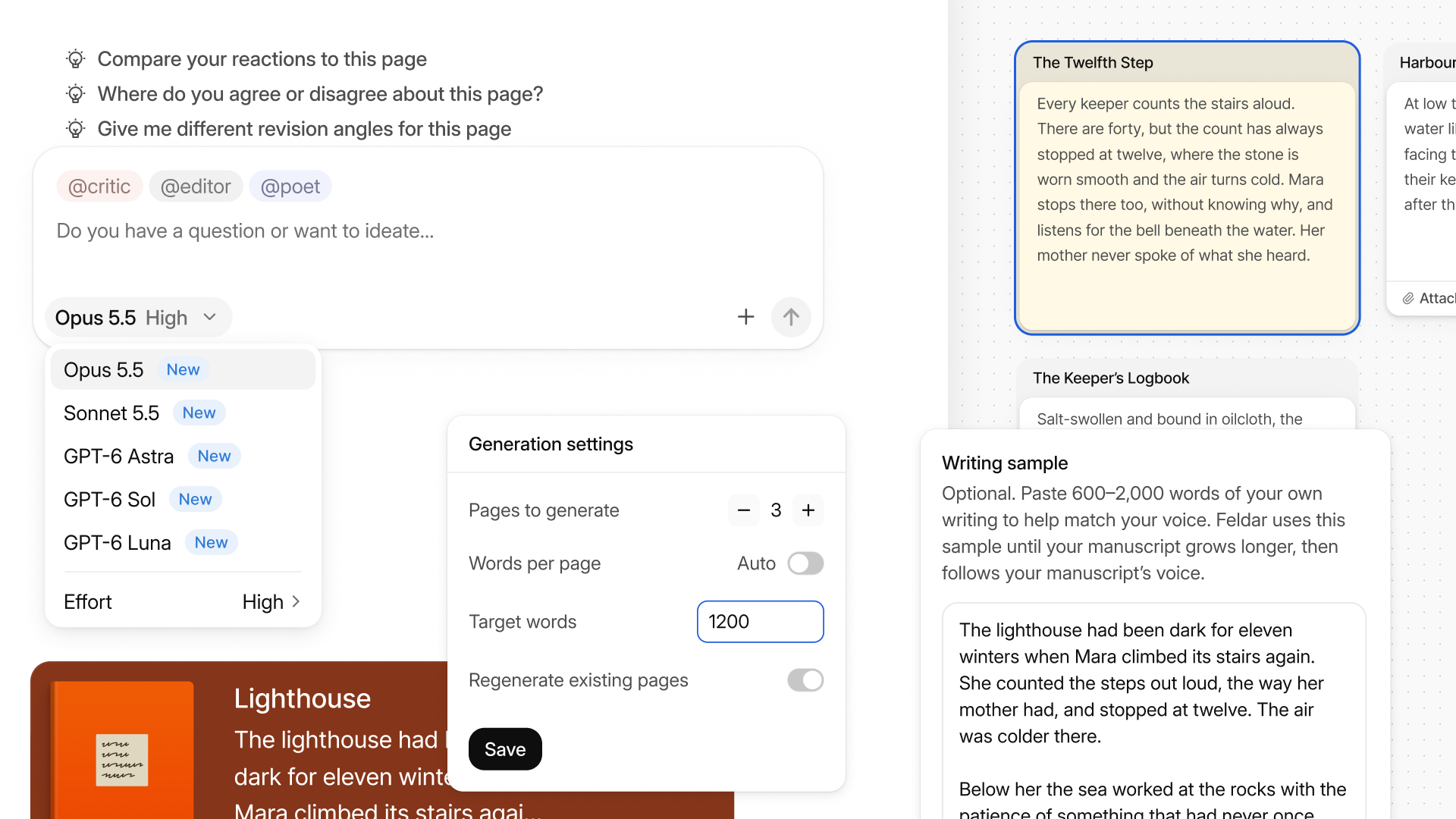
Feldar 1.1 showing new AI models, generation settings, a writing sample, and Canvas cards

Writing that sounds like you

Feldar starts with your global voice sample. As your project grows, it switches to the local prose, so suggestions reflect the work you're writing. Rewrites stay closer to your meaning, with consistent typography that sits cleanly beside your own prose.

Newer models

Feldar now supports GPT-6 Astra, Sol, and Luna, alongside Claude Opus 5.5 and Sonnet 5.5. Choose the model that suits the work.

Drafting that keeps its place

Word targets are adjustable, and Feldar remembers your drafting settings between sessions. Stronger continuity carries a draft's thread across page breaks.

A clearer Canvas and Chat

Canvas places cards more intelligently and supports deeper zoom. Chat adds starter prompts and easier persona controls. Navigation is clearer, with more consistent light and dark modes.

Work that holds up

Stronger draft recovery and conflict handling reduce lost or overwritten changes. Checks are more reliable, and Feldar recovers from dropped connections without interrupting your work.
Provenance for your writing

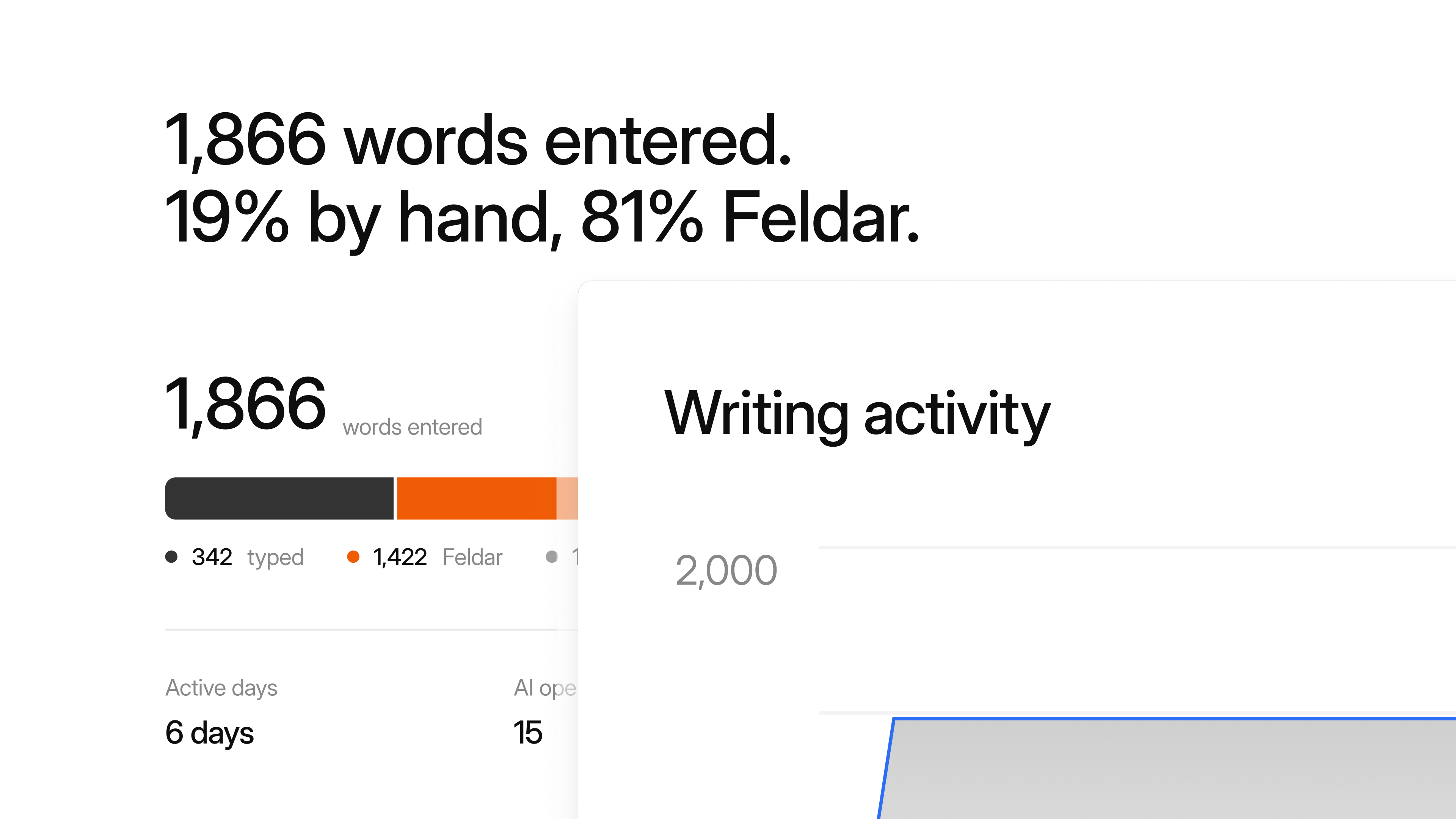
Feldar now preserves a private record of how a manuscript was made, distinguishing direct writing from contributions made with Feldar tools.

Feldar provenance showing 1,866 words entered, with 19 percent written by hand and 81 percent contributed through Feldar

A record created with the work

Provenance is recorded as you write. When you apply a Feldar tool to a manuscript, Feldar preserves that contribution and distinguishes it from language written directly by you.

This creates a history of the process alongside the document. Instead of asking a detector to infer origin from finished prose, the record shows how the work took shape inside Feldar.

Private and owned by the writer

Your provenance record is private. Where disclosure matters, you can use it to explain how you worked without turning your writing over to a classifier or treating a probability score as proof.

Schools, workshops, publishers, and other institutions can set their own standards for acceptable assistance. Provenance provides evidence of the process without imposing one rule on every kind of writing.

Clear claims, with clear limits

Feldar records activity that happens inside Feldar. It cannot identify text generated elsewhere and then manually typed into a document. The record is designed to be precise about what it knows rather than make claims about activity it never observed.

This boundary is what makes the record useful: it replaces a guess about the final text with definite statements about the writing process Feldar actually witnessed.

Read more about why we built this in Provenance, Not Detection.